
Jake Bowers puts a strong case for judging this case on the facts, not on prejudice. The Roma blogger Pipopotamus and the novelist Louise Doughty have also made sensible contributions to the debate.

Building a community-based organisation
Conference highlights
The conference achieved its primary objective of engaging the communities. Although the attendance was less than we would have hoped, almost half of those present were from the communities. The new executive, elected at the AGM following the conference, has significant community representation. The day also served its purpose in identifying a number of areas where ACERT could support the development of activists and role models. We recognise much more needs to be done but we began to lay the foundations.
 Romanies and Travellers in Higher Education
ACERT has a role in:
- providing information and advice to young people in secondary schools making career choices
- helping parents come to terms with their children’s’ choices
- supporting students copeing with the challenges of Higher Education
- balancing community needs with individual opportunities.
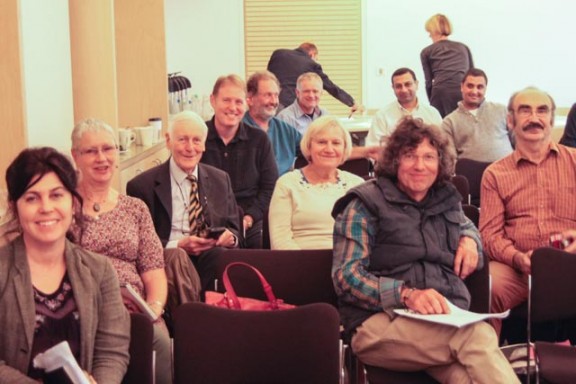
ROMED reunion
- ROMED was a special event for all concerned, but left many of the participants wanting more training and opportunities to use their skills
- ACERT will explore how we can put on further training, and also help the trainees market their skills to potential clients.
Dreammakers
- Issues of identity and ethnicity were discussed, with art being and appropriate medium to explore these issues
- ACERT will work in partnership with art practitioners, to develop opportunities for young people to explore and express who they are.
- ACERT will also develop its website (and social media) to keep information flowing about what’s going on.
We also heard about People of the Road and the Community Empowerment Network.
Lord Avebury
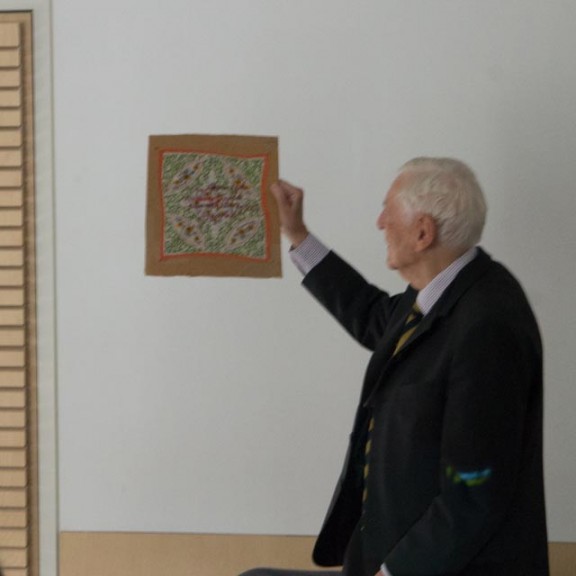
Our President has stood down, after 13 years, on grounds of ill-health. He was presented with two embroidered handkerchiefs by Delaine Le Bas, which were exhibited in the first Roma pavillion at the Venice Biennale 2007.
A full conference report can be downloaded below.
[wpdm_file id=118 title=”true” ]
AGM 2013
Annual General Meeting
September 28 2013
Notice of the AGM was circulated to members and contacts on August 19 2013. Details are posted on the ACERT website.
Agenda
- Welcome and Apologies
- Chair’s Annual Report of the work done by ACERT
- Treasurer’s report
- Adoption of audited Accounts
- Election of Honorary Officers 2013 -2014
- Chair
- 2 Vice Chairs
- Treasurer
- ·Election of Committee 2013-2014
- ·Appointment of Auditor(s)
- ·Date of next AGM
- ·AOB
Only paid up members have voting rights.
Those wishing to stand for election must have been a member of ACERT for at least 3 months.
Nominations for Honorary Officers or members of the Committee may be made by members of ACERT in writing. The nomination and the consent of each nominee must be received prior to the meeting.
Nominations may also be taken from the floor of the meeting. Those nominated must give consent.
The total number of Committee Members including Officers is not more than 15.
{wpdm_category=agm-2013}
Advice and support for families facing exclusion from school

The Community Empowerment Network has asked ACERT to publicise their services amongst the Travelling communities.
Marc Lorenzi writes:
” I am concerned that year after year Traveler’s feature among the most
disproportionately excluded and under achieving groups however we don’t
receive referrals or enjoy any type of narrative with Travelling
communities.
This is a snapshot of what we can offer:
- Support with young people at risk of exclusion
- Free legal advice and representation
- Exclusion appeals
- Support with school reintegration
- Advocacy training for practitioners. “
We’d be happy to receive feedback from any ACERT members who use this service.
Other information of ACERT’s exclusions campaign.