
Date for your dairy: Saturday 20th September 2014

acert-logo

Partnerships

ACERT 2014 Conference and AGM

20th September 2014 9-30am to 4-00pm

George Fox Room
Friends Meeting House
173 Euston Rd
London NW1 2BJ

With minimal commitment from central government, and limits on charitable funding, voluntary organisations have to maximise their effectiveness through partnership and cooperation. The aim of this free conference will be to give and overview of recent development in the UK and Europe as well as showcasing exciting things happening in the UK now. We hope to provoke interest and discussion from participants to help shape ACERT’s agenda for 2014-5. The AGM, which will be between 12-30 and 1-00pm, will elect the Executive Committee which will be  responsible for implementing our decisions.

We would be happy to hear from any organisations or individuals who would like to tell us about initiatives in which they are involved, and we will send out a more detailed agenda after our next EC in mid-July.
Book here

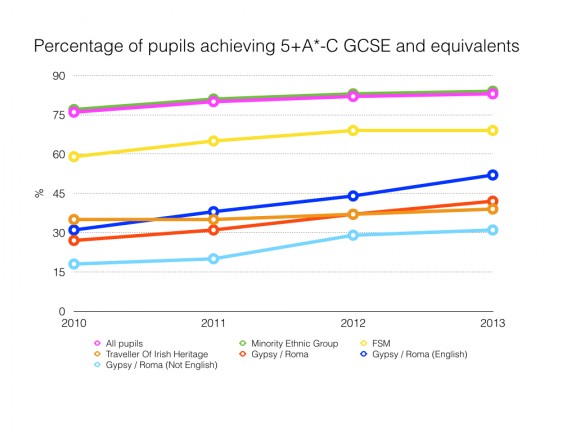
Gypsies narrow the attainment gap, but Irish Travellers flat-line

Data provided by the DFE, in response to a request from ACERT, suggests that the gap between Gypsies and other pupils at GCSE is beginning to close, but that Irish Traveller achievement at 16 is flat-lining. Both these figures must also be read in the context of significant drop-out throughout the secondary phase and the substantial number of Gypsies, Roma and Travellers who change their ethnic identification.

ACERT asked for the data on the Gypsy/Roma group (red) to be split into pupils who have English as a home language (royal blue) and those who don’t (light blue). This method was used in the NFER study “Improving Outcomes for Gypsy, Roma and Traveller pupils” and broadly separates established Gypsy communities from more recently arrived Roma groups.


GCSE equiv 5+A-C

The data also suggests that:

  • Gypsies, Roma and Travellers especially Roma start at a significant disadvantage.
  • Roma are the lowest achieving group but the gap has narrowed in KS1 Average Points scores.
  • Irish Travellers narrowed the gap at KS2 in Reading and Maths
  • Irish Traveller Fixed Term Exclusions remain high, while Gypsy exclusions have fallen.
  • Gypsies are narrowing the gap at GCSE (5+A-C E%M) but Irish Travellers are flat-lining; better picture 5+AtoG.
  • Attendance for all groups has improved although Gypsy, Roma and Traveller attendance remains significantly below others
  • Numbers of Roma in the school population have increased substantially but remain small as a proportion of total population
  • Increasing numbers English First Language Gypsy/Roma in Primary, but not in secondary
  • Dropout remains a huge problem and KS3 and 4

The full data and a presentation are available at https://acert.org.uk/education-data-2012-3/

2nd UK ROMED course March 26th to 29th 2014

ROMED trainees
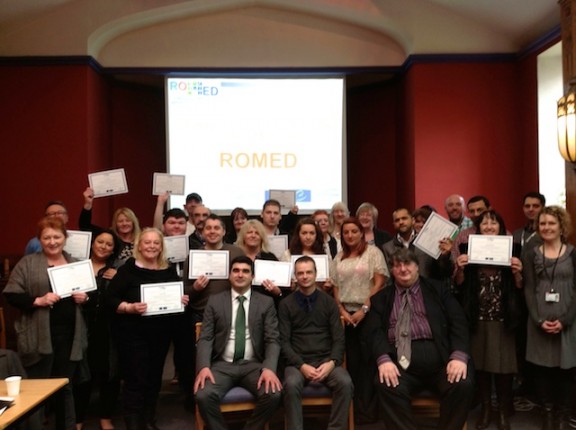
Successful trainees, with Council of Europe representatives, at the end of 2013 UK ROMED training

ACERT has just been granted further Council of Europe and EU funding to run a second ROMED mediator training programme.

To attend the 3.5 day training course apply online here. The deadline for applications is midnight on Monday March 3rd

The first 3 ½ day residential session of this two part course begins on 26th March 2014 at 4pm at Luther King House,  Manchester. The second 3 day session will be held in about six month’s time. In the interim, participants will be asked to undertake a work-based assignment using their learning from the course. Accommodation, meals and travel expenses are all covered. Applicants will need to obtain their employers’ prior consent to take time off to attend.

On Thursday March 27th new participants, their employers and representatives from the public sector and local authorities will be offered the opportunity to find out more and to consider how ROMED could improve intercultural understanding in their own areas. Some of the original trainees and a representative from the Council of Europe will share their stories.

There will be discussion about how the  ROMED model could be further developed in the UK. The ROMED 2 programme, which is running in ten other European countries,  supports local community action groups to develop a closer dialogue with local and public authorities. There is a possibility that the UK might at some stage join in with this programme. For further information on the website.

On Friday and Saturday March 28th  and 29th  trainees will undertake the very participative ROMED training programme. These sessions will be led by UK based facilitators, some of whom are community members.

If you represent a local authority and would like to join us as a day delegate on Thursday March 27th please contact info@acert.org.uk and I will send you further information. If you wish to attend and need overnight accommodation this may be available at Luther King House. 

High Court rules council must fund Traveller child with disabilities

The High Court has ruled councils must support disabled children in travelling families, even when they move to other parts of Britain.In a decision welcomed by the Equality and Human Rights Commission, the court ruled Worcestershire Council must support a three-year-old boy even when he is in another part of the country.
The boy, who has Down’s syndrome as well as other complex medical conditions, is part of a travelling Roma Gypsy family.

The family travels across England working at fairs during the summer, but is based in Malvern, Worcestershire, in the winter.

The council had declined to fund nursery services for the boy, known as Child J, while the family were travelling.

But Justice Edward Holman said there were ‘powerful submissions’ that it was unrealistic for Child J to access services from scratch every time the family moved to a different local authority area.

The judge said: ‘Everyone loves a funfair. They are part of the tapestry of our national life. But there would be no funfairs without the travelling families who own the rides and amusements, erect them, man them, and then take them onto the next pitch.

‘It must be a hard life and a hard working one, but it is a good life and an honourable one, which brings fun and joy to many people.’

He ruled that Worcestershire Council was able to exercise its power outside of its area, and should continue funding any provision it had put in place for the child.

Wendy Hewitt, legal director at the EHRC, said: ‘This important ruling means that this little boy, and others in similar situations, can now continue their traditional way of life without fearing the loss of essential services to meet their health and educational needs.’