Jubilee message from Vice President of the International Romani Union

Juan de Dios Ramírez-Heredia Montoya is President of Spanish Unión Romaní and Vice President of the International Romani Union

You can hear this message in the voice of Juan de Dios Ramírez-Herediaby clicking on the following link: https://youtu.be/B4jMs07MmGE

In 1971 the “Iron Curtain” and the “Berlin Wall” seemed impregnable walls

April 8 was declared International Roma Day at the first World Romani Congress. Now it is celebrated around the world.

    On April 8, the Romani people go to the riverbanks to throw flowers into the river. It is the symbol of freedom, crossing borders, and the Earth as a shared place for all the people. 

       After that, we leave floating lights on the still waters of the river to remember our ancestors. We never forget the half-million Romani people who died in concentration camps under the Nazi regime after World War II. 

      We are living hard times. Our people are still being prosecuted, also in democratic countries. Some of them arrive in Europe fleeing from hunger and misery with the hope of a better life, but they are expelled. We must raise our voices to demand a more tolerant society and we have to ask our governments to show solidarity. We cannot lose hope. 

      On April 8, we must go out onto the street with a smile and we have to offer our hand to whoever wants to shake it. If people want to listen to us, we have to tell them who we are. Our people have nothing to do with what is portrayed in some mass media. 

     On April 8, we should feel proud of belonging to a great community. We are more than fourteen million people around the world. Fourteen million human beings with a common history, with a common language, with a largely shared culture, and with the desire to continue being Romani of the 21st century.

At the London Congress, a dream came true

      Fifty years have passed since on April 8, 1971, a group of Romani people from 28 different countries met in London to talk about our aspirations at that moment and to think about our futures. This was a unique event, absolutely unthinkable for many of the people who attended the Congress. It was in London where we discovered that we wanted to be the architects of our future and the administrators of our freedom. 

      There were only Romani people, in the London Congress. Most of them came from former communist countries. We should not forget that three-fourths of the European Romani population came from Russia and its satellite states. That is why we were very interested in what the people who came from those countries could tell us. In 1971 the “Iron Curtain” and the “Berlin Wall” seemed impregnable walls.

Great achievements of the London Congress

      Those of us who were lucky enough to participate in that meeting agreed we should have a flag to represent us. And we approved it: it is blue and green. We also wanted a universal hymn to sing during our celebrations. Jarko Jovanovich composed it with his balalaika. In 1978 we were recognized by the United Nations. We thought we should create an academic institution to work on the normalization and standardization of our language, Romano. It happened thanks to René Descartes University in Paris and Marcel Courthiade, may God have him in his glory. Finally, we created the International Romani Union. The goal was clear: to culminate a political project and to represent the Romani people around the world. 

Names for History

      The first of all is Vanko Rouda, founder of the International Gypsy Committee. Also, his brother Leula and Grattan Puxon, the General Secretary of the London Congress. They were the soul of the Congress. Slobodan Berbeski was the president of the Congress and Dr. Jan Cibula was elected the first president of the International Romani Union. Jarko Jovanovich, composer of Gelem, Gelen and Raya Rudikova, a Romani girl form Russia. The list is very long. 

Meanwhile, in Spain

      In 2017, on March 10, the Congress of Deputies urged the Government to officially declare April 8 as the International Roma Day, as well as to recognize the blue and green flag with a red 16-spoke wheel and the Gelem Gelem as our anthem. “The purpose was to use those symbols in commemorations, acts and institutional events related to the Romani People.”

      On April 6, 2018, the Council of Ministers of Spain approved the recognition of April 8 as the International Roma Day, as it has been done in the past in the Council of Europe and different countries. The Plenum of the Senate of Spain joined this celebration through a solemn institutional declaration.

      The Unión Romaní calls on all citizens to join us on this important and relevant date.

Share

Fully-funded foundation year at Cambridge

The University of Cambridge’s Foundation Year Programme offers a fully-funded, year-long, residential programme, targeted at students who have experienced a range of educational disadvantages or disruptions.

The academic entry requirement is 120 UCAS points. This is equivalent to BBB at A-Level, but allows for easy equivalence of a wide range of Level 3 qualifications, and for fair consideration of combinations of qualifications such as BTECs and A-Levels.

The new Foundation Year will admit its first class of students in October 2022. Interested students will apply directly to the Foundation Year via UCAS by the January 2022 deadline for study beginning in October 2022. You can find out more here: www.cam.ac.uk/foundationyear.

Students admitted to the Foundation Year will also receive a full scholarship to cover rent and other living costs.

On the Foundation Year, students can expect a challenging academic curriculum in the arts, humanities and social sciences. This offers the best possible preparation for the rigours of a Cambridge degree by broadening and deepening knowledge and understanding as well as introducing the ways students learn at Cambridge.

Students admitted onto the Foundation Year will become part of a College community; they will live alongside other undergraduates and have full access to all the University’s societies and facilities. Their learning will be supported by lectures, seminars and supervisions.

An important aspect of the programme is to provide a new pathway to a Cambridge degree for students who have experienced disadvantage and disruption during their education. Therefore, from an early stage in the Foundation Year’s academic programme, senior academic staff in Colleges will be providing students with advice and support regarding their degree subject choice.

All Foundation Year students who complete the programme with a Pass or above will receive a recognised Level 4 CertHE qualification from the University of Cambridge, which will enable them to access a wide range of undergraduate level courses. Those attaining at 65% or higher will be able – should they wish to do so – to progress straight through to a full undergraduate degree at Cambridge in one of eighteen courses in the arts, humanities and social sciences.

Share

World Roma Congress Jubilee website opens

Every place, there is Roma, there is Romanistan.

Slobodan Berberski, president of the First World Roma Congress in 1971,

https://youtu.be/ETO1tEc46wI

From the 8th April 2021 the online congress to mark the 50th Anniversary of the World Romani Congress will be stretched over a month starting in London and moving to Berlin joining cities as far apart as Belgrade and Buenos Aires, activists from Barcelona to Bangalore, in India

Events can be enjoyed via a live stream at www.romanistan.com a virtual place that crosses all continental borders and connects Romani people worldwide.

On 8th April 1971, the World Romani Congress founding event was held in London. It was a crucial point in the history of Romani people and is now seen as the beginning of the worldwide Romani emancipation movement. It started a political fight for equality, mobilised through Romani organisations, and the unifying flag and anthem. 

This year to mark the jubilee anniversary you are invited to join a series of diverse online events that will offer the opportunity to connect communities across the globe to celebrate Romani history and culture but also critically reflect on the ongoing challenges that are still faced by Romani people worldwide

Events can be enjoyed via a live stream at www.romanistan.com a virtual place that crosses all continental borders and connects Romani people worldwide.

At a time of rising far-right extremism and anti-gypsyism it is hoped that this anniversary year will bring Romani people and our allies around the world closer together, to create a common purpose, celebrate achievements, and build a stronger collective voice.

Grattan Puxon, one of the co-organisers of the First World Romani Congress
Share

Ryalla Duffy 11th April 1959 – 10th March 2021

It was with great sadness that we learnt of the sudden passing of Ainlee Ryalla Duffy.

Ryalla had lived the life, lit many fires and told many stories.

Siobhan Spencer

Ryalla was well known to many ACERT members. She participated in the ROMED training in 2014 and, as well as participating actively in the training and discussions, she submitted an exceptional personal study.

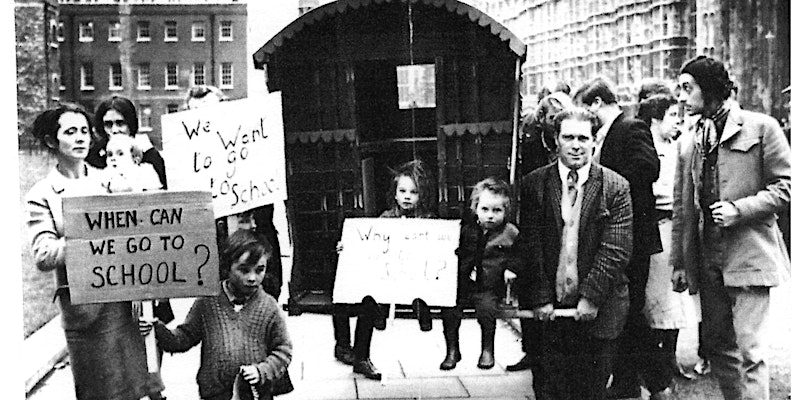
“The period since [waggon time] has seen a gradual, intentional and unrelenting erosion of rights of an entire way of life, aided and abetted by legislation and media bias.”

Ryalla Duffy

Ryalla and her family went through endless enforcements themselves from 1987 in Sussex when they had to leave their own land. She was well known in the southern counties (as well as the Midlands).

Ryalla was an excellent representative for her people and Romany rights. She was very knowledgeable of the New Forest families and saw the comparisons of enforced camps and the final solution and wrote a chapter on this history of the “compounds” in the Patrin book as part of the Patrin project with the Monitoring Group, seeing the similarities of this particular aspect of Romany Gypsy history.

Ryalla worked hard in Lincolnshire and was responsible for getting the much-needed work undertaken on the Summergangs Lane site, in Gainsborough.

…. a wonderful character who fought continuously for her people and their rights and who was the author of several books and the star of 2 or 3 dvds.. She was also the subject of the classic Anglo Romani book ‘Born on the Straw’ by Dorothy Strange (1968). The community will miss her hugely and I shall miss a very dear friend. 

Bob Dawson

In 2005 Ryalla was one of the founder members of the National Federation of Gypsy Liaison Groups and took part in police training, parliamentary meetings and conferences.

Despite the knocks, it illustrates her sense of humour and the truth in life and how I would like to remember her.One of the last days we spent together was with Lord Bourne, for a heritage tribute as he laid a wreath at the grave of Private John Cunningham receiver of the Victoria Cross, in commemoration of the 100 years centenary of the Great War, a great day with her which, as usual, ended with great laughter.

Siobhan Spencer

She leaves behind her 4 daughters, 2 sons and all of 13 grandchildren.

Share