High Court rules council must fund Traveller child with disabilities

The High Court has ruled councils must support disabled children in travelling families, even when they move to other parts of Britain.In a decision welcomed by the Equality and Human Rights Commission, the court ruled Worcestershire Council must support a three-year-old boy even when he is in another part of the country.
The boy, who has Down’s syndrome as well as other complex medical conditions, is part of a travelling Roma Gypsy family.

The family travels across England working at fairs during the summer, but is based in Malvern, Worcestershire, in the winter.

The council had declined to fund nursery services for the boy, known as Child J, while the family were travelling.

But Justice Edward Holman said there were ‘powerful submissions’ that it was unrealistic for Child J to access services from scratch every time the family moved to a different local authority area.

The judge said: ‘Everyone loves a funfair. They are part of the tapestry of our national life. But there would be no funfairs without the travelling families who own the rides and amusements, erect them, man them, and then take them onto the next pitch.

‘It must be a hard life and a hard working one, but it is a good life and an honourable one, which brings fun and joy to many people.’

He ruled that Worcestershire Council was able to exercise its power outside of its area, and should continue funding any provision it had put in place for the child.

Wendy Hewitt, legal director at the EHRC, said: ‘This important ruling means that this little boy, and others in similar situations, can now continue their traditional way of life without fearing the loss of essential services to meet their health and educational needs.’

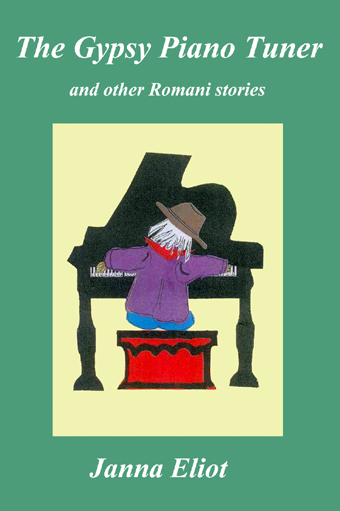
The Gypsy Piano Tuner and other Romani stories.

AA The Gypsy Piano Tuner - Front cover THUMBNAIL (1)Janna Eliot is a writer based in London of Russian, Armenian and Roma heritage. Her collection of short stories is not the traditional Gypsy, Roma and Traveller tales but contemporary accounts of based, one suspects, on actual events.

The stories range from that of Eva, a survivor of the concentration camps, who meets her sister from whom she has been separated for sixty five years,  Gabi, a Romanian Roma girl living with her family in squalid conditions in Italy, Peri from London who goes to the Great Amazing Romany Summer School in Serbia, Joey and his brother Mark, who enter a singing competition at Barnet Horse Fair, Zena from Russia who begs at the bus station and takes comfort by talking to a statue of the poet Pushkin, who was dark like a Gypsy, to young Irish Traveller girl Breed living on Dale Farm refusing to go to school for fear of being taken into care. 

Interestingly, for ACERT members, Lord Averbury makes an appearance in this story opening of the community centre on the site. Breed was expecting him, being a lord, to have ‘red robes and long white wigs’ but she says, “He was a grand talker though, and a supporter of the Travellers.”

Janna portrays her characters with sensitivity to their marginal position in society and her understanding and empathy with their culture and history. Some of the stories are harrowing, but at the same time she brings out the pride and resilience inherent in Gypsy, Roma and Traveller peoples. Janna has a good ear for language and her characters come alive through the dialogue. A  Romani/English glossary is provided following each story.

This collection of short stories gives an insight into Gypsy, Roma and Traveller communities across the UK and Europe today and is highly recommended.

Review by Tim Everson

The Gypsy Piano Tuner – softback 104 pages

£7.99 plus £2.51 p&p = £10.50

To order, please send a cheque payable to R L Hollands,

Lamorna Publications, Yew Tree Studio, Marshwood, Bridport, Dorset DT6 5QF

Or telephone to order by credit/debit card: 01297 678140

www.lamornapublications.co.uk

Building a community-based organisation

Conference highlights

The conference achieved its primary objective of engaging the communities. Although the attendance was less than we would have hoped, almost half of those present were from the communities. The new executive, elected at the AGM following the conference, has significant community representation. The day also served its purpose in identifying a number of areas where ACERT could support the development of activists and role models. We recognise much more needs to be done but we began to lay the foundations.

IMG_1680 Romanies and Travellers in Higher Education

ACERT has a role in:

  • providing information and advice to young people in secondary schools making career choices
  • helping parents come to terms with their children’s’ choices
  • supporting students copeing with the challenges of Higher Education
  • balancing community needs with individual opportunities.IMG_1678

ROMED reunion

  •  ROMED was a special event for all concerned, but left many of the participants wanting more training and opportunities to use their skills
  • ACERT will explore how we can put on further training, and also help the trainees market their skills to potential clients.

Dreammakers

  • Issues of identity and ethnicity were discussed, with art being and appropriate medium to explore these issues
  • ACERT will work in partnership with art practitioners, to develop opportunities for young people to explore and express who they are.
  • ACERT will also develop its website (and social media) to keep information flowing about what’s going on.

We also heard about People of the Road and the Community Empowerment Network.

Lord Avebury

Our President has stood down, after 13 years, on grounds of ill-health. He  was presented with two embroidered handkerchiefs by Delaine Le Bas, which were exhibited in the first Roma pavillion at the Venice Biennale 2007.

IMG_1667

A full conference report can be downloaded below.

[wpdm_file id=118 title=”true” ]